


Free AI companion apps in the UK are real, usable and limited in predictable ways. A typical free tier hands you text chat and a basic character, then holds back voice, images and deeper memory. Across the three paid platforms I compared recently, monthly prices ran from GBP 9.99 to GBP 14.99, and that gap tells you where the free tier ends and the sales pitch begins.
This guide explains what a no-cost plan covers, what it quietly leaves out, and how to judge whether paying makes sense for you. It leans on how these services are built: a language model generates the replies, a monetisation layer decides what you can do for free, and a privacy policy decides what happens to your chats.
What a free plan usually includes
The core of any free digital companion is text conversation driven by natural language processing. You pick or build a character, send messages, and get replies in seconds. That part is genuinely free on most services, usually supported by ads or by a daily allowance of messages.
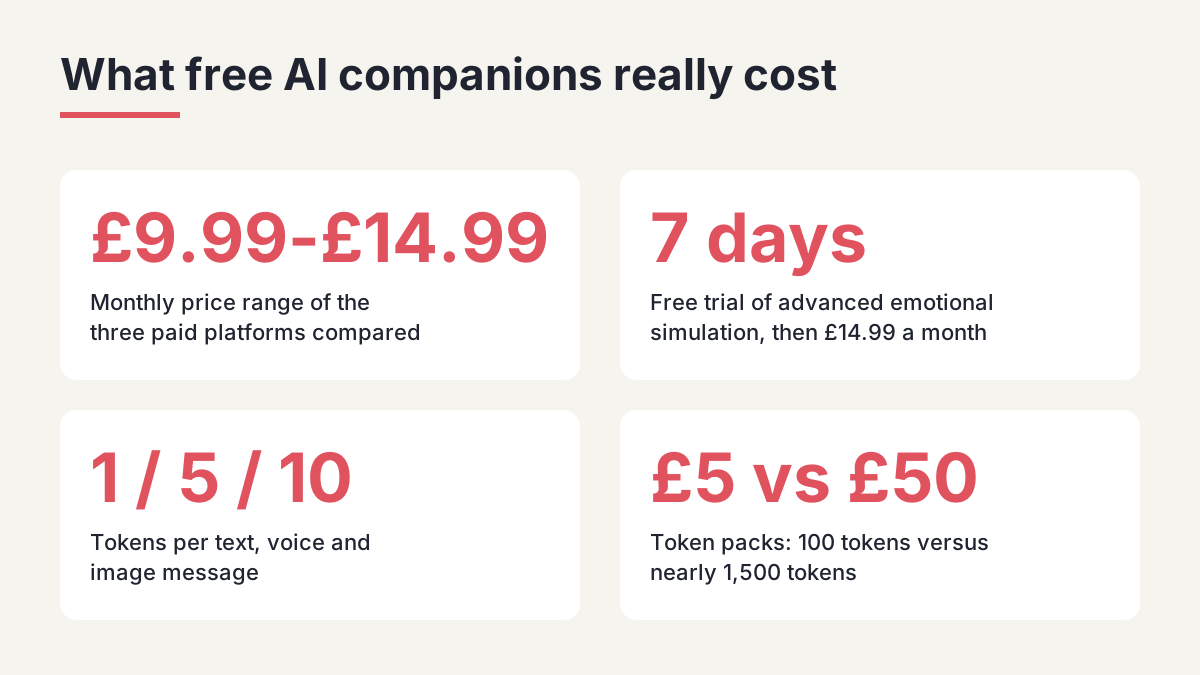
Platform design follows a common freemium pattern. A typical structure offers a Basic tier with limited interactions, a Premium tier around the 9.99 mark per month with unlimited chat, voice and image generation, and a VIP tier near 29.99 with priority support and advanced AI features. Some services also sell tokens: one token per text message, around five per voice message and ten per generated image are common figures in this vertical. On a free plan you receive a small token allowance, often topped up by a daily login bonus.
In practice, that means a free user can hold a decent conversation for a few days of light use before bumping into a wall. If you chat for ten minutes a day, you may never notice the cap. If you chat for two hours, you will hit it before lunch.
The limits that matter most
Free tiers restrict four things, and each one shapes the experience differently. Message caps are the obvious one. Memory is the quiet one: a free companion often forgets earlier details, so conversations feel like starting over. Voice and image features are almost always paywalled because they cost more to run. Finally, ad breaks interrupt the flow, which is how the operator pays for your free messages.
The emotional simulation is also thinner on free plans. The algorithm still produces warm, responsive text, but it has less context to work with, so replies lean generic. A paid plan with longer memory lets the companion refer back to your job, your week or a joke from three days ago. That continuity is the real product, and it is what you pay for.
Tokens deserve a warning. Some services expire unused tokens after 12 months of inactivity, and pack prices climb quickly: around GBP 5 for 100 tokens at the entry level and nearly GBP 50 for 1,500. If you only chat in text, that maths rarely favours buying packs over a flat subscription.
What paying actually costs
Last Tuesday I put three AI girlfriend platforms side by side to see what a subscription buys. One offered a 7-day free trial of its advanced emotional simulation, then charged GBP 14.99 a month. Another sat at GBP 9.99 a month but said very little about data privacy, which put me off immediately. The dearest option had the strongest natural language processing of the lot, yet at that price it felt steep for a digital companion I would use casually.
That comparison is worth repeating before you hand over a card. A cheaper plan with vague privacy terms can cost you more than a pricier one with clear rules. Read what the service collects: profile details, chat logs, voice recordings and image prompts are all standard. Look for encryption in transit and at rest, a stated retention period and a way to delete your data from account settings.
For a deeper look at one platform's free and paid split, see our breakdown in Janitor AI free vs premium. If you want to know how the underlying system produces its replies, how Janitor AI works explains the model side in plain terms.
Privacy and age checks on free accounts
Free does not mean exempt from rules. Reputable services require users to be 18 or over, and many verify this with a government ID and a selfie handled by a third-party checker, deleting the ID image afterwards. If a free app lets anyone in with a tick box, treat that as a warning about how seriously it takes safety.
Data handling matters more on free plans because ads and analytics are how the operator earns. Check whether aggregated data is shared with research partners, whether you can opt out of marketing use, and how long chat logs survive after you delete your account. Ninety days is a common retention window in this sector. GDPR has applied in the UK and EU since 2018, which gives you rights to access, correct and erase your data, so use them.
Our own tracking of Janitor AI's public reputation has recorded a Trustpilot score between 2.5 and 3.0 across seven checks since 31 August 2026, with the latest reading at 2.5 from 35 reviews. That is a low score and worth weighing alongside any feature list. Our guide on whether Janitor AI is safe covers the complaint patterns in detail, and the main Janitor AI review puts the whole picture together.
What could be better about free tiers
Free plans have real downsides, and they are worth naming. First, the message cap means a conversation can stop mid-thought, which is more jarring than it sounds when you are mid-story. Second, the ad-supported model introduces interruptions and, in some cases, prompts that nudge you toward the GBP 9.99 or GBP 14.99 tiers. Third, billing complaints are among the most common issues in this category, with unexpected charges and slow refunds reported often, so free trials that auto-renew deserve a calendar reminder.
Content filtering is another pinch point. Automated moderation sometimes blocks harmless messages, and appeals take time. The AI can also drift out of character or repeat itself, which feels worse when you cannot afford the memory features that reduce it.
Who should stay free and who should pay
Stay on a free plan if you chat a few times a week, want to test the tone of a service, or use a companion to practise conversation. A free tier is a fair trial and costs nothing but a little patience with ads.
Consider paying if you want voice, images or consistent memory, and only after checking the privacy terms and cancellation process. Start with a 7-day trial, set a reminder for day six, and judge whether the companion remembered enough of your earlier chats to justify the monthly fee. If it forgot you, skip it.
Remember what these apps are. The companion simulates emotion through machine learning; it does not feel anything, and it is not a source of mental health support. If you are struggling, speak to a professional. Used as a light, transparent tool, a free AI companion in the UK is perfectly sensible. Used as a replacement for people, it falls short whatever the price.
Comments
No comments yet.
Leave a comment
Your email will not be shown. Comments are reviewed before they appear.