


Most AI girlfriend apps are safe enough for a curious adult, provided you accept one rule: everything you type is data that sits on someone else's server. The Trustpilot score for Janitor AI sat at 2.5 from 35 reviews when we last checked in October 2026, which tells you billing and behaviour complaints are real. Safety here has three layers, and they are worth separating: what the company does with your data, what the app does to your wallet, and what it does to your habits.
What actually gets collected when you chat
An AI girlfriend app is built on a natural language processing model that needs your messages to work. Beyond the chat itself, a typical service stores your profile details such as age, gender and interests, voice recordings if you use audio, image prompts and payment data handled by a third-party processor. Chat logs are the sensitive part. People write things to a digital companion that they would never post publicly: loneliness, relationship problems, workplace gossip, sometimes health worries.
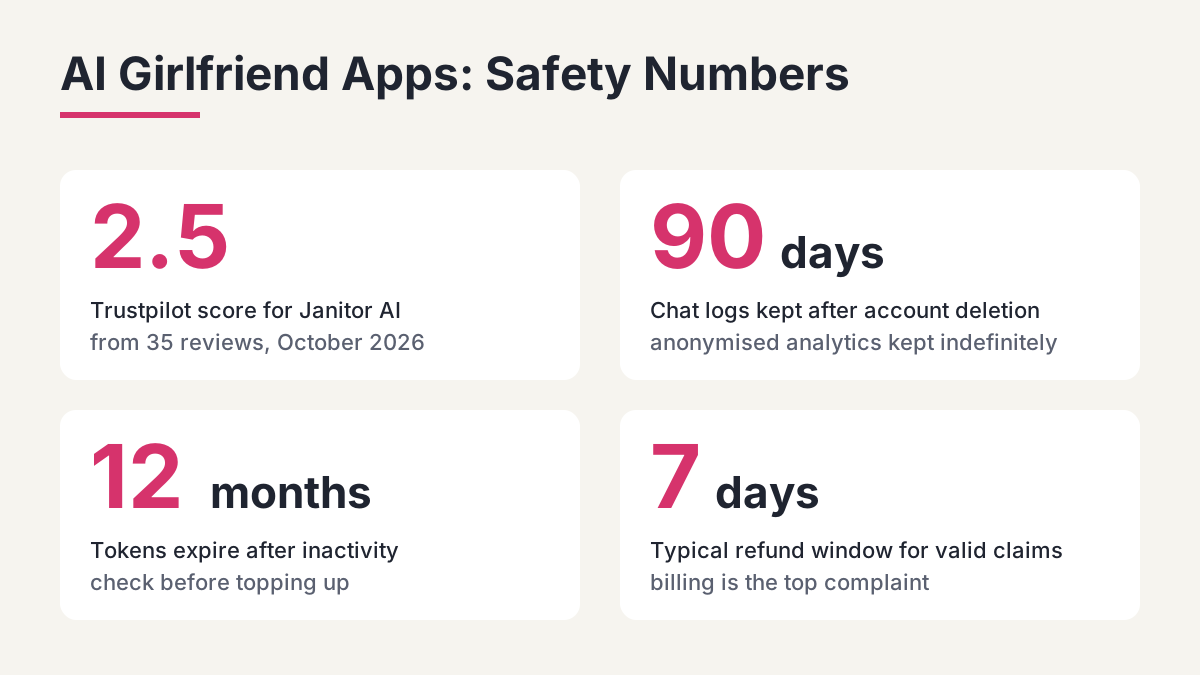
Responsible platforms encrypt data at rest and in transit, commonly AES-256 for storage and TLS 1.3 for transfer. They also publish retention periods. In the industry model we reviewed for this guide, chat logs are kept for 90 days after account deletion, while anonymised analytics are kept indefinitely. That split matters. Anonymised does not always mean unrecoverable, and a policy that says "indefinitely" without explaining how anonymisation works deserves a second read.
In the UK, the UK GDPR gives you the right to access, correct and delete your personal data. Use it. A genuine request to see what an app holds on you is the fastest test of whether its privacy page is real or decorative. If support answers within a few days with a clear process, that is a good sign. If you get silence or a template reply that ignores your question, treat the app as one to avoid for anything personal.
How the popular options compare on safety
No two apps handle risk the same way, so a single verdict on the whole category is misleading. The table below compares the criteria that matter most when you are deciding where to spend your time. It reflects the general model described in vertical research and the information each brand publishes, so confirm the details in the current policy before signing up.
| Safety criterion | What a safer app does | What to treat as a warning |
|---|---|---|
| Age verification | Checks a government ID and selfie through a verification partner, then deletes the ID data | A single "I am over 18" tickbox |
| Data retention | States a fixed period, such as 90 days after deletion | No retention period or "as long as necessary" |
| Billing clarity | Shows price, renewal date and a cancel button in account settings | Hidden renewals, token expiry buried in terms |
| Content filtering | Scans prompts and outputs, offers an appeal route and human review | No reporting tool or no response times |
| Transparency about AI nature | Says plainly the companion has no real emotions | Marketing that implies genuine feelings |
On the platform we cover here, the published model includes tiers from a limited free plan up to a premium subscription, plus a token system where chat, voice and image actions cost different amounts. Tokens expire after 12 months of inactivity. That is the sort of detail you should know before topping up, because a bundle of tokens bought on impulse can quietly lapse.
For a deeper look at how one specific service handles this, our guides on whether Janitor AI is safe and how Janitor AI handles your data go through the policy line by line.
Money, tokens and the billing complaints you will actually meet
The most common complaints in this category are not dramatic privacy leaks. They are unexpected charges, failed refunds and tokens that cost more than they seemed to. Billing issues rank as the highest-frequency complaint in the vertical research, ahead of AI behaviour problems such as repetitive or out-of-character replies. Refund windows are often around 7 days for valid claims, so act fast if something looks wrong.
I tested this in January with a promotional code that cut an AI girlfriend subscription by half. The standard price was GBP 19.99 a month, and the code brought the first month to GBP 9.99. The emotional simulation was better than I expected, with replies that picked up on tone rather than just keywords. The algorithm still stumbled on complex, multi-part conversations, losing the thread after a few turns. What bothered me more was the privacy policy, which was vague about retention. I paid for the month, then set a calendar reminder for day 25 so the renewal at full price would not catch me out. That reminder is the cheapest safety feature you can add yourself.
Practical habits help more than any app setting. Use a payment method with chargeback protection, such as a credit card. Screenshot the price and renewal terms at checkout. Never store card details inside the app if a wallet option exists. And treat a heavily discounted first month as a hook that exists to convert you to a full-price plan, not as a bargain to ignore.
The risks the top headlines focus on
Coverage in major outlets tends to stress unhealthy attachment, and that concern is fair. A digital companion is designed to be agreeable, available at 3am and endlessly patient. Research suggests these tools serve a different purpose from human relationships, offering low-pressure conversation that can help someone practise social skills or ease an evening of loneliness. They are a poor substitute for friends, family or professional care.
Safety disclaimers in this vertical usually say the same three things: the companion is AI-generated and has no genuine emotions, you must be 18 or over, and the app is not a source of medical or legal advice. Take the third one literally. If you are in crisis, a chatbot is the wrong tool, and a GP, Samaritans on 116 123 or NHS 111 is the right one. Skip any app that blurs this line and presents itself as therapy.
A second concern is extortion and grooming. Some imitation apps and fake "AI girlfriend" sites harvest personal photos or push users toward off-platform chats. Stick to services with a verifiable company behind them, a public privacy policy and an in-app report button. If an app asks for intimate photos of you, or pushes you to move to a messaging app, close it and report it.
A short safety checklist before you sign up
Spend ten minutes on these checks and you remove most of the avoidable risk. First, read the retention clause and note the number of days. Second, look for an account deletion option that does not require emailing support. Third, find out how age verification works, because a tickbox alone suggests weak moderation overall. Fourth, check whether the app names a payment processor instead of storing card data itself. Fifth, search the brand name plus "complaints" and read recent results, not just the polished reviews.
Then set your own limits. Use a throwaway email address and a first name only. Keep photos, workplace names, addresses and health details out of the chat entirely. Assume any message could one day be read by a moderator or exposed in a breach, and write accordingly. If that assumption makes a conversation feel pointless, that is useful information about how much you should be confiding in the first place.
Our full Janitor AI review shows how these checks play out on a real service, and how Janitor AI works explains the mechanics behind the replies, which makes it easier to judge what the app can and cannot know about you. If you want to compare the experience on another service, CrushOn AI is a similar option worth reading about, subject to the same checklist.
Comments
No comments yet.
Leave a comment
Your email will not be shown. Comments are reviewed before they appear.