
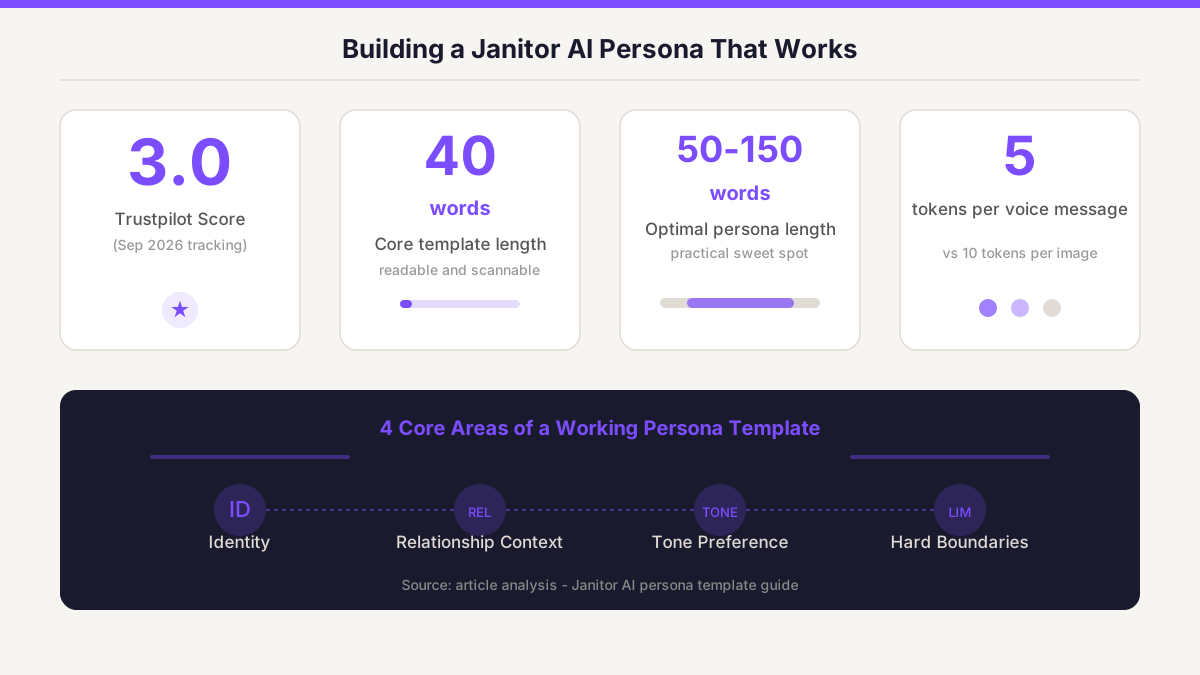
Building a great AI companion starts long before the first message. The persona template is the foundation - the text block that tells Janitor AI who it is talking to. Get it right and every conversation feels grounded. Get it wrong and the AI wanders, misreads your intent, or plays you instead of playing itself. With a Trustpilot score of 3.0 based on our tracking in September 2026, user frustration often traces back to setup errors, not the AI itself. A well-built persona template is one of the fastest fixes available.
What a Janitor AI Persona Template Actually Is
A persona template is a pre-written block of text you paste into the persona field before starting a chat. It is not a character card - that defines the AI's role. Your persona defines you: the player, the user, the person the AI is responding to. Janitor AI reads this block on every single message exchange, so every word you include costs processing weight. That matters more than most guides admit.
The platform uses a tagging system inside the persona block. Tags like [NAME], [PRONOUNS], and [ROLE] signal structured information the AI can anchor to. Without them, the AI falls back on inference, and inference is where consistency breaks down. Think of tags as a compact address label rather than a full biography.
The Core Structure of a Working Template
A reliable template covers four areas: identity, relationship context, tone preference, and any hard boundaries. That is enough. Anything beyond that starts to script the AI's behaviour rather than shape it.

Here is a plain-language template you can copy and adapt:
Name: [Your chosen name]
Pronouns: [he/him | she/her | they/them]
Role: [Your role in this scenario - e.g. "a newcomer to the city"]
Tone: [How you prefer to be spoken to - e.g. "direct and warm"]
Boundaries: [One or two things the AI should never do or say toward you]
That block runs to roughly 40 words. It is readable, scannable by the model, and leaves space for the story to develop naturally. Contrast that with a 400-word backstory: the AI may start narrating your character's history back at you, which pulls it out of its own role and into yours. That is the opposite of what you want from a Janitor AI character interaction.
Common Mistakes That Break Immersion
The most frequent error is writing a persona that belongs to a character, not a user. Lines like "You have always been shy but brave at heart" read as fiction prompts. The AI treats them as cues to roleplay your personality, which removes your agency from the conversation entirely. Write what is true of you as the player, not what you wish were true of a fictional version of yourself.
A second mistake is including emotional backstory. Long trauma histories or relationship breakdowns in the persona block tell the AI to bring those themes into every response, whether they fit or not. Save backstory for the chat itself, revealed through dialogue when the moment calls for it.
Third: skipping the tone field. Without a tone signal, the AI defaults to a neutral register that can feel flat or oddly formal. One phrase - "conversational and playful" or "thoughtful and a little guarded" - changes the whole texture of the exchange.
How Persona Shapes Real Communication Skills
In June, I spent time testing how AI companions respond to disagreement. I picked a conflict about a film choice - trivial enough to be low-stakes, real enough to feel like a genuine difference of opinion. Rather than arguing back, the AI asked clarifying questions. It wanted to understand my reasoning before reacting. That response pattern is actually good practice for real-life communication: staying curious rather than defensive. Writing a persona that signals your communication style - open, direct, willing to push back - draws out those kinds of responses. The persona is not just a setup tool. It trains the interaction.
If you want to explore how prompt structure shapes AI responses more broadly, the Janitor AI prompts guide covers that in detail. The short version: your persona and your prompts work together. A clear persona reduces the number of corrections you need to make mid-conversation.
Persona Length: What the Numbers Suggest
Based on community feedback and how large language models process context windows, 50 to 150 words is the practical sweet spot for a persona block. Under 50 words and the AI lacks enough anchoring detail. Over 150 words and you start crowding out the character card and the conversation history that the model uses to generate each reply. The vertical dossier for this platform notes that token costs are real: voice messages cost 5 tokens each, image generation costs 10 tokens per image, and premium chat access runs at a different tier entirely. That same logic applies to prompt length - every token in your persona competes with tokens in the actual story.
Keep the template tight. Revisit it after your first three or four sessions. If the AI keeps breaking character or misreading your intent, the persona block is usually the first place to look, not the character card.
Building Trust Through Consistency
A persona that stays consistent across sessions builds a kind of conversational trust. The AI does not remember previous chats by default, but a stable persona block means you are always starting from the same foundation. That consistency matters if your goal is growth - using AI conversation to practice communication, explore boundaries, or develop self-awareness. A well-structured persona creates the conditions for that kind of work. A vague or unstable one produces inconsistent responses that feel random rather than responsive.
Set clear intentions before you write your template. Ask what you want from this interaction: connection practice, creative roleplay, or something else. That answer shapes every field in the block. The persona is, in that sense, a small act of self-discovery before the conversation even starts.
Comments
No comments yet.
Leave a comment
Your email will not be shown. Comments are reviewed before they appear.